• Log In

RERC on AAC

  • Home
  • People
  • News
    • Future of AAC Research Summit – 2024
    • News
    • Presentations
    • Publications
    • Archives (2014-2020)
      • R1: Brain-computer interface
      • R2: Supporting transition to literacy
      • R3: Visual cognitive processing demands
      • D1: Multimodal technologies
      • D2: Interactive video visual scene displays
      • D3: Smart Predictor app
      • D4: Cognitive demands checklist
  • Research
    • R1: Video Visual Scene Display (VSD) Intervention
    • R2: AAC Literacy Decoding Technology
      • Design of the transition to literacy (T2L) decoding feature
    • R3: Motion to improve AAC user interface displays
    • Consumer & Technology Forums
      • Communication with Direct Support Professionals: The Experiences of AAC Users (2024)
      • The participation of people who rely on AAC in the pre-service preparation of communication, education, and medical professionals (2023)
      • The patient-provider experiences of people with CP who use AAC (2022)
  • Development
    • D1: Access Assistant Software to Improve Alternative Access Services
    • D2: Smart Select: a new switch access method
    • D3: mTraining in AAC for Communication Partners
  • Training
    • T1: Mentored Research and Lab Experiences
    • T2: Rehabilitation Engineering Student Capstone Projects
    • T3: Student Research and Design Challenges
    • T4: Doctoral Student AAC Research Think Tank
    • T5: Webcasts & Instructional Modules
  • eBlast & Dissemination
    • eBlast
    • Free ePrints
    • Presentations
    • Publications
  • Webcasts & Instructional Modules

T2: Rehabilitation Engineering Student Capstone Projects

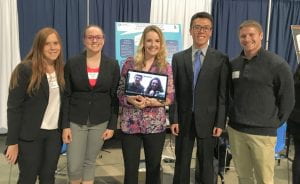
student teamPurpose: There are two goals for the senior engineering capstone projects: (1) to provide specific training in collaborative R&D in AAC for engineering students; and (2) to contribute to the development of new prototypes to address the unmet needs of individuals with CCN.

Activities: We will work with the Penn State Learning Factory to support at least 75 engineering students in completing AAC engineering capstone experiences (at least 15 students per year for 5 years).


Spring 2021

Simple Prototype Grid Application

Team members: Abby Riggio, Brad Beltran, Aron Jalbuena, Guohao Shen, Tzu Hsiang Yeh, William Ye & Yuchun Wu (Biomedical Engineering, Computer Engineering, Computer Science, Data Science)

Recent Publications and Presentation

Patrick Regan and a quote from his article in the AAC journal

The first word in accessibility is “access” (Regan, 2025)

Patrick Regan (2025) is President-Elect of USSAAC, and he also plays leadership roles in ISAAC, and in outreach programs for the Bridge School. Patrick experiences Spinal Muscular Atrophy, and has used a wide variety of AAC to communicate. In this paper, he describes “access challenges that I have experienced as someone who uses AAC, how my team and I have resolved them, and what challenges I face now.”

Now free at the AAC journal
https://doi.org/10.1080/07434618.2025.2513912

Other recent activity

Conferences

Recent

ASHA (2024) handouts and virtual posters

ATIA (2025) handouts

Upcoming

ASHA 2025


Follow the RERC on Facebook!

Follow the RERC on Facebook!

Copyright © 2026 · Enterprise Pro Theme on Genesis Framework · WordPress · Log in

The contents of this website were developed under a grant from the National Institute on Disability, Independent Living, and Rehabilitation Research (NIDILRR grant number 90REGE0014) to the Rehabilitation Engineering Research Center on Augmentative and Alternative Communication (RERC on AAC). NIDILRR is a Center within the Administration for Community Living (ACL), Department of Health and Human Services (HHS). The contents of this website do not necessarily represent the policy of NIDILRR, ACL, or HHS, and you should not assume endorsement by the Federal Government.