• Log In

RERC on AAC

  • Home
  • People
  • News
    • Future of AAC Research Summit – 2024
    • News
    • Presentations
    • Publications
    • Archives (2014-2020)
      • R1: Brain-computer interface
      • R2: Supporting transition to literacy
      • R3: Visual cognitive processing demands
      • D1: Multimodal technologies
      • D2: Interactive video visual scene displays
      • D3: Smart Predictor app
      • D4: Cognitive demands checklist
  • Research
    • R1: Video Visual Scene Display (VSD) Intervention
    • R2: AAC Literacy Decoding Technology
      • Design of the transition to literacy (T2L) decoding feature
    • R3: Motion to improve AAC user interface displays
    • Consumer & Technology Forums
      • Communication with Direct Support Professionals: The Experiences of AAC Users (2024)
      • The participation of people who rely on AAC in the pre-service preparation of communication, education, and medical professionals (2023)
      • The patient-provider experiences of people with CP who use AAC (2022)
  • Development
    • D1: Access Assistant Software to Improve Alternative Access Services
    • D2: Smart Select: a new switch access method
    • D3: mTraining in AAC for Communication Partners
  • Training
    • T1: Mentored Research and Lab Experiences
    • T2: Rehabilitation Engineering Student Capstone Projects
    • T3: Student Research and Design Challenges
    • T4: Doctoral Student AAC Research Think Tank
    • T5: Webcasts & Instructional Modules
  • eBlast & Dissemination
    • eBlast
    • Free ePrints
    • Presentations
    • Publications
  • Webcasts & Instructional Modules

Student Engineering Partnerships for Spring 2017

June 1, 2017 by David McNaughton

The RERC on AAC partnered with three student engineering Learning Factory teams at Penn State University in the spring of 2017. The student teams met with David McNaughton on a weekly basis, and developed engineering solutions to communication related challenges. All students were undergraduates in biomedical engineering, computer science, computer engineering, and mechanical engineering.  All projects were presented at the Penn State  Learning Factory showcase.
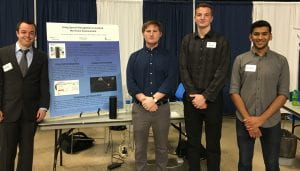

four studentsUsing Speech Recognition to Control the Home Environment: The Penn State student team of  David Harrington, Ryan Henderson, Peter Mason, Dhruva Seelin worked with Tom Jakobs and Ethan Williams of Invotek , and Anthony Arnold, to address the challenge of using Amazon Alexa as a method of environmental control for persons with complex communication needs. The students developed an Alexa skill to support Anthony in using Alexa to review his Gmail messages, and a “proof of concept” Raspberry Pi prototype.
  •  poster
  •  report


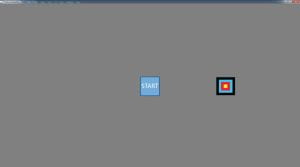
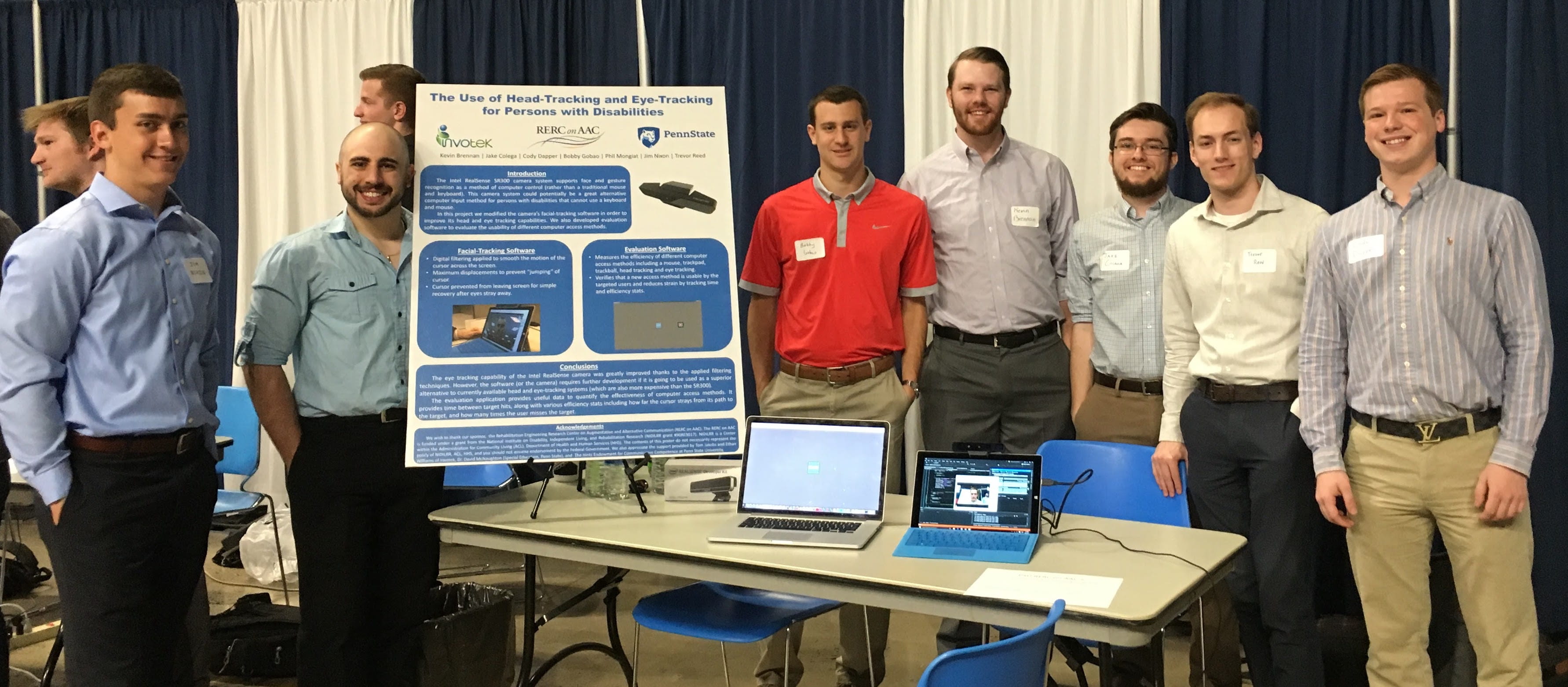
screenshotEvaluation Software for Computer Application Methods: The Penn State student team of Kevin Brennan, Jacob Colega, Cody Dapper, Robert Gobao, James Nixon, Trevor Reed, and Philip Mongiat worked with Tom Jakobs and Ethan Williams of Invotek to develop a software tool to evaluate the effectiveness and efficiency of different access techniques.
  • report 
  • poster

This student project placed third in the RESNA Student Design Competition


chatbot image
 
Developing a ChatBot to Support Practice in the Use of Active Listening Skills. The Penn State team of Michael Judge, Vishnupriya Bakthisaran, and  Daniel Levine developed a working ChatBot to support practice in the use of Active Listening skills by pre-service assistive technology specialists. The ChatBot will be a working part of a module on collaboration skills for the RERC on AAC MOOC.

  • report
  • poster

Filed Under: News, Research, Student project

Subscribe

Subscribe to receive the eBlast  four times per year

Recent Posts

  • The first word in accessibility is “access” (Regan, 2025)
  • Alternative ways to access AAC technologies (Ramirez, 2025)
  • Future of AAC technologies: priorities for inclusive innovation (Williams & Holyfield, 2025)
  • Nothing about AAC users without AAC users: a call for meaningful inclusion in research, technology development, and professional training (Blasko et al., 2025)
  • To include us in our own worlds: AAC is not optional (Koloni, 2025)

Recent Publications and Presentation

Patrick Regan and a quote from his article in the AAC journal

The first word in accessibility is “access” (Regan, 2025)

Patrick Regan (2025) is President-Elect of USSAAC, and he also plays leadership roles in ISAAC, and in outreach programs for the Bridge School. Patrick experiences Spinal Muscular Atrophy, and has used a wide variety of AAC to communicate. In this paper, he describes “access challenges that I have experienced as someone who uses AAC, how my team and I have resolved them, and what challenges I face now.”

Now free at the AAC journal
https://doi.org/10.1080/07434618.2025.2513912

Other recent activity

Conferences

Recent

ASHA (2024) handouts and virtual posters

ATIA (2025) handouts

Upcoming

ASHA 2025


Follow the RERC on Facebook!

Follow the RERC on Facebook!

Copyright © 2026 · Enterprise Pro Theme on Genesis Framework · WordPress · Log in

The contents of this website were developed under a grant from the National Institute on Disability, Independent Living, and Rehabilitation Research (NIDILRR grant number 90REGE0014) to the Rehabilitation Engineering Research Center on Augmentative and Alternative Communication (RERC on AAC). NIDILRR is a Center within the Administration for Community Living (ACL), Department of Health and Human Services (HHS). The contents of this website do not necessarily represent the policy of NIDILRR, ACL, or HHS, and you should not assume endorsement by the Federal Government.