
Children with complex medical and communication needs often experience extensive or frequent hospital stays and rely on augmentative and alternative communication (AAC) strategies to communicate in this environment. In order for these AAC strategies to be successfully implemented, providers need the skills for successful implementation. Health care providers seldom receive training to effectively communicate with these children, which may lead to limited participation opportunities for the child during inpatient interactions.
Parent insights on barriers, supports, and priorities for children with cortical visual impairment and complex communication needs (McCarty & Light, 2023)

McCarty, T. V., & Light, J. C. (2023). “It’s like a guessing game all the time”: Parent insights on barriers, supports, and priorities for children with cortical visual impairment and complex communication needs. Augmentative and Alternative Communication, 39(4), 256–269. https://doi.org/10.1080/07434618.2023.2206904
AAC Interventions for children with visual and motor impairments (Brittlebank et al., 2024)

Individuals with multiple disabilities are among the most challenging to serve and AAC teams often lack direction in determining effective interventions. Children with both visual and motor impairments often have complex communication needs. Often the the term multiple disabilities is used to capture individuals who experience two or more impairments. This scoping review focused on the research evidence on AAC interventions for individuals with complex communication needs and multiple disabilities.
Effects of an AAC Decoding Feature on Single-Word Reading by Individuals With Down Syndrome (Holyfield et al., 2023)
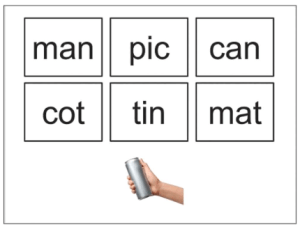
This article describes how a decoding feature in the T2L program affects single-word reading. The words were targeted in adapted books with individuals with Down syndrome. Participants showed increased reading ability including decoding novel words.
Using video VSD during a volunteer activity for adolescents with CCN (Babb et al., 2020)
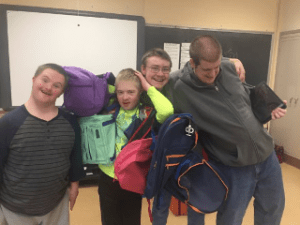
In this study, Babb and colleagues used video VSDs with adolescents with autism spectrum disorder or Down syndrome while they participated in a volunteer activity.
- « Previous Page
- 1
- 2
- 3
- 4
- …
- 18
- Next Page »
